Autoflower Cannabis in a LetPot: Air Gap and Droop Recovery
Flower clusters developed
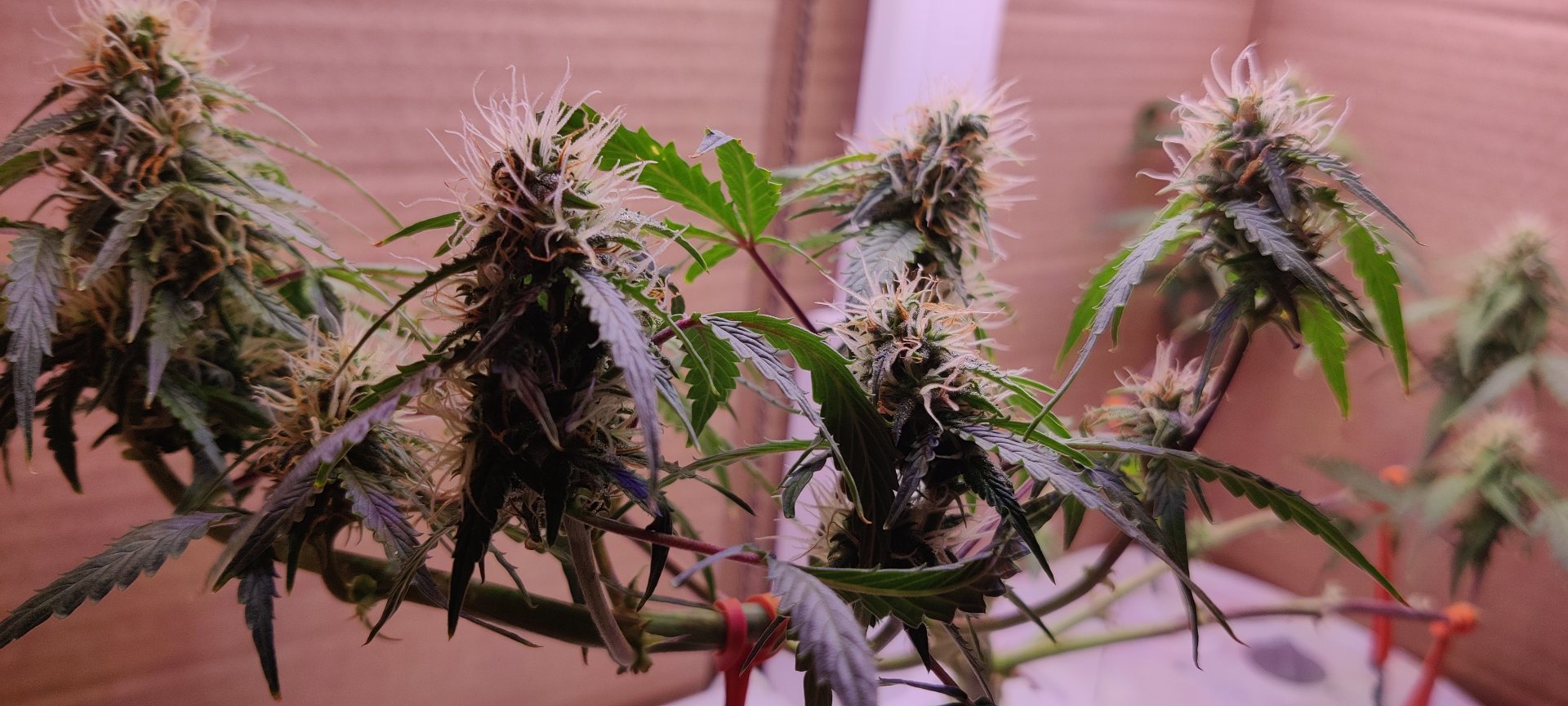
Over the long interval, early flower sites became several developed clusters. The plant is progressing in flowering, with moisture inspection now the main prevention focus.
Observation
24 January 2026
- Plant
- Autoflower cannabis
- Health
- 🌸 Late flowering - inspect for moisture
- Momentum
- Flower development advanced
- Case decision
- No Case Change
Visual evidence
What Dud2Bud observed
Flower development has advanced dramatically and is the dominant change. The plant appears to be in a later flowering phase, with some expected leaf senescence but no clear active disease or pest pattern in the visible flowers.
Several flower clusters are substantially larger than at the previous photo.
Flowers have abundant visible pistils and continued reproductive development.
The branches are supported and the plant remains structurally intact.
No obvious gray mold, webbing, or wet rot is visible in the photographed flowers.
Some foliage is dark, drooping, or senescing around the flower clusters.
The flowers are dense, increasing the importance of airflow and moisture inspection.
The root zone, reservoir, waterline, and current solution strength are not visible.
Old damage
Older leaf yellowing, browning, and prior tip damage from the earlier nutrient and root-zone stress.
Old damage
Previously damaged leaves that are now fading without clear evidence of spreading into flower tissue.
Still uncertain
The long 972.8-hour interval contains no intermediate photos, so the exact flowering timeline is unknown.
Still uncertain
The close framing does not show the whole plant or the complete environment.
Still uncertain
Flower surfaces are partly obscured, so a single image cannot rule out hidden moisture or early mold.
Still uncertain
Current nutrient strength, pH, EC, humidity, and airflow are unknown.
Dud2Bud decision
Protect dense flowers from moisture problems
Flower clusters are now dense enough that hidden moisture and poor airflow matter more than the older cosmetic leaf damage.
What to do
Keep conditions steady and inspect flowers
Do not change the reservoir or nutrient strength based on this photo. Keep the support and airflow routine steady, and briefly inspect dense flower clusters for trapped moisture, gray fuzz, or soft brown tissue.
- 1 Keep the flower canopy dry.
- 2 Inspect the densest flower sites from more than one angle.
- 3 Maintain gentle airflow around, not directly blasting, the flowers and leaves.
Exact change
none
Keep steady
Keep the current nutrient strength, waterline, air gap, light schedule, and support unchanged. Avoid wetting the flowers.
Check your own plant
Does your plant look similar?
Upload one photo. Dud2Bud looks at the visible symptoms, growing setup and recent changes, then gives you a practical first step.
First report free · No app required
Full assessment
How this photo was assessed
The report separates visible facts, possible explanations and the final care decision so uncertainty remains visible.
Visible evidence What was visible in the photo
Vigor
WatchFlower production is active, while some foliage senescence and posture decline should be monitored.
Confidence: 73%
Color Analysis
WatchColor changes are compatible with flowering maturity and prior stress, but current solution chemistry cannot be inferred reliably.
Confidence: 68%
Growth Development
ClearReproductive development has progressed substantially since the last check-in.
Confidence: 94%
Progress Comparison
ImprovingThis is a major positive developmental progression over the long photo interval.
Confidence: 95%
Damage Classification
WatchThe visible leaf decline may be late-flowering senescence or residual stress, but flowers should be checked closely for a new problem.
Confidence: 67%
Distribution Analysis
ClearThe dominant pattern is broad flowering progression, not a localized outbreak.
Confidence: 76%
Possible mechanisms What could explain it
Disease
WatchMold risk is an environmental concern to inspect, not a confirmed disease in this photo.
Confidence: 58%
Nutrition
WatchNutrition may influence leaf color, but there is not enough evidence to change the established solution solely from this image.
Confidence: 42%
Environment
WatchAir movement and moisture control are now more important because dense flowers can develop hidden humidity pockets.
Confidence: 72%
Biotic Damage
ClearPests are not the leading explanation from this view.
Confidence: 70%
Water Relations
WatchWater relations should remain steady, but current posture does not establish an urgent root-zone problem.
Confidence: 42%
Structural Analysis
ImprovingSupport is useful and should be maintained as flower weight increases.
Confidence: 78%
Decision checks Why this action was chosen
Recovery
ImprovingThe earlier vegetative stress did not prevent successful flowering progression.
Confidence: 90%
Information Gap
WatchFurther evidence is useful for prevention, but it should be low effort and focused on flower health.
Confidence: 77%
Limiting Factor
WatchMoisture control and flower inspection are the most relevant prevention priorities, but no corrective treatment is indicated yet.
Confidence: 61%
Confidence Audit
ImprovingConfidence is high for flowering progression and moderate for late-flowering health interpretation.
Confidence: 86%
Intervention Evaluation
Not VisibleThis is a developmental comparison, not a controlled intervention test.
Confidence: 95%
Check your own plant
Does your plant look similar?
Upload one photo. Dud2Bud looks at the visible symptoms, growing setup and recent changes, then gives you a practical first step.
First report free · No app required
This supporting report documents the visual evidence and care decision from one point in a longer plant journey. It is not indexed separately from the main plant story.