Autoflower Cannabis in a LetPot: Air Gap and Droop Recovery
Growth continued, posture worsened
The canopy expanded since baseline, but broad droop appeared across the plant, so a root-zone water and oxygen balance case was opened and one reservoir-level test was selected.
Observation
23 November 2025
- Plant
- Autoflower cannabis
- Health
- 🌿 Active mild-to-moderate stress
- Momentum
- Growth continued, posture worsened
- Case decision
- Open Case
Visual evidence
What Dud2Bud observed
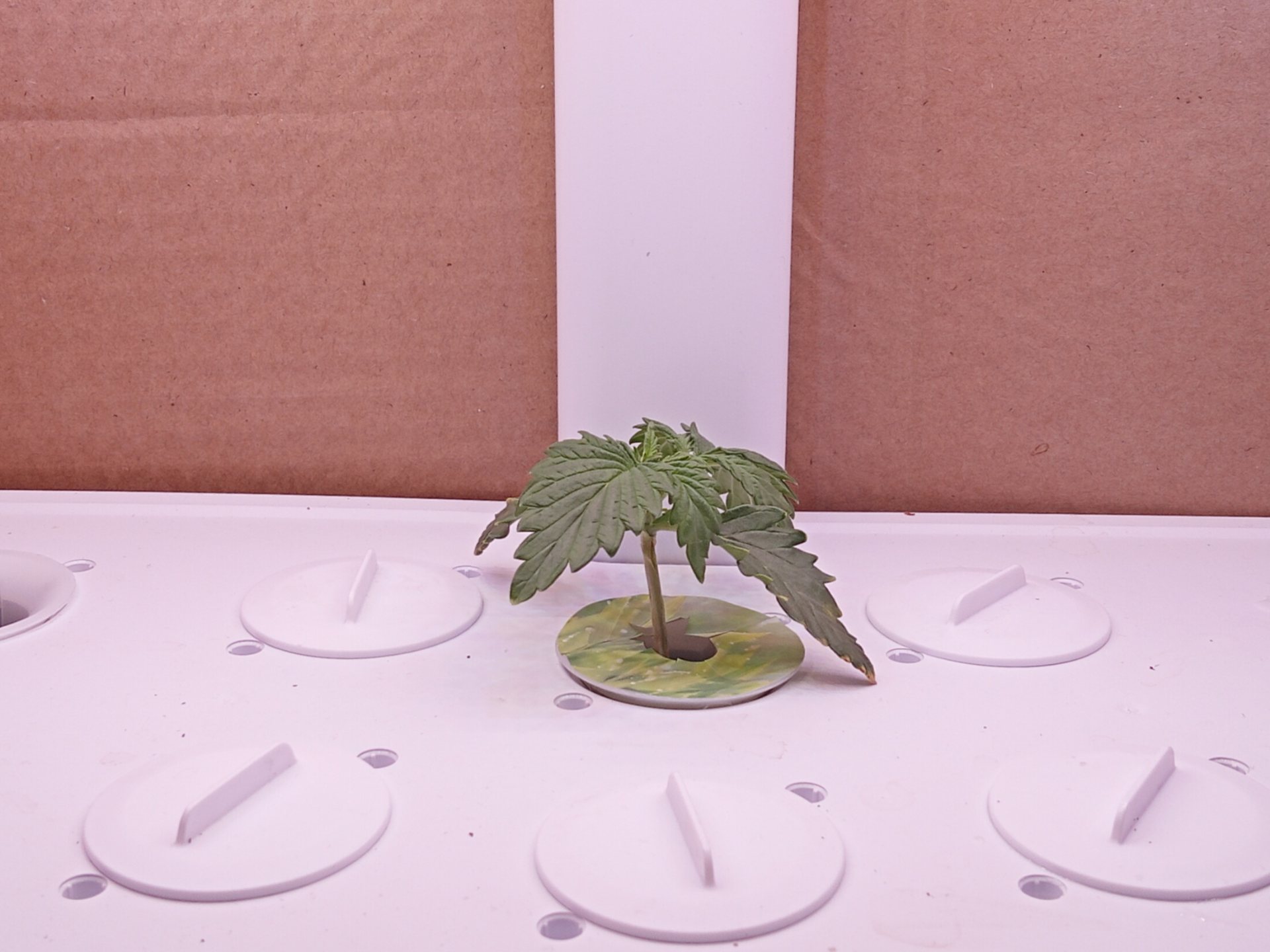
Growth has continued, but posture has worsened from upright to broadly drooping. The strongest actionable hypothesis is root-zone water or oxygen balance in this lid-supported hydro setup, although the exact mechanism is not confirmed.
The canopy is larger than in the previous photo, showing continued growth over 199 hours.
New central leaves are present and remain green.
The stem is still upright and supporting the plant.
Most visible leaves now hang downward, including the outer leaves.
Some older foliage appears lighter and less vigorous than the central growth.
The root area, waterline, and solution condition remain hidden.
Active new damage
Broad leaf droop is visible across the current canopy compared with the previous photo.
Active new damage
The plant appears more burdened by canopy weight or root-zone stress than at baseline.
Old damage
The earlier single dark lower leaf is no longer the main decision signal; the current whole-canopy posture matters more.
Still uncertain
The droop could reflect water access, root oxygen balance, light demand, or normal leaf angle in this cultivar.
Still uncertain
The photo does not show roots, reservoir level, solution strength, or airflow.
Still uncertain
No user-confirmed care change is available.
Dud2Bud decision
Restore a safer root-zone balance
Broad droop is now affecting the whole canopy, and this hydroponic setup makes water contact and air space the most practical reversible factors to test first.
What to do
Make one small reservoir adjustment
Check the reservoir and adjust the solution level so it sits just below the bottom of the net pot or support, keeping a visible air gap rather than submerging the stem or entire medium.
- 1 Inspect the reservoir or waterline before changing anything.
- 2 Adjust only the solution level, not nutrient concentration.
- 3 Keep the plant stem and crown above the solution and preserve a small air gap below the support.
Exact change
Adjust the reservoir so solution reaches the lower root area or net-pot base without covering the stem or saturating the entire collar; keep a small air gap below the support.
Keep steady
Keep nutrient strength, light schedule, and plant position unchanged for this test.
What happened before the next photo
Topped up + added 5ml A/B each.
Check your own plant
Does your plant look similar?
Upload one photo. Dud2Bud looks at the visible symptoms, growing setup and recent changes, then gives you a practical first step.
First report free · No app required
Full assessment
How this photo was assessed
The report separates visible facts, possible explanations and the final care decision so uncertainty remains visible.
Visible evidence What was visible in the photo
Vigor
ConcernGrowth is occurring, but current vigor is limited by a condition affecting water balance, roots, or demand.
Confidence: 78%
Color Analysis
WatchA broad nutrient diagnosis is not supported, but root function or nutrient uptake may be limiting older foliage.
Confidence: 67%
Growth Development
ImprovingThe plant has continued vegetative development despite the current posture problem.
Confidence: 82%
Progress Comparison
ConcernThe trajectory is mixed: development is positive, but short-term posture has worsened.
Confidence: 85%
Damage Classification
WatchThis looks more like physiological stress than clear pest damage.
Confidence: 67%
Distribution Analysis
ConcernA whole-plant process such as water access, root oxygen, or environmental demand is more plausible than isolated leaf aging.
Confidence: 76%
Possible mechanisms What could explain it
Disease
WatchDisease or root decay cannot be ruled out, but the photo does not justify treating for it first.
Confidence: 48%
Nutrition
WatchNutrition may contribute, but changing nutrient strength before checking root-zone conditions would be a weak first experiment.
Confidence: 45%
Environment
WatchDemand may have increased as the plant grew, but the hydro root zone should be stabilised before changing light or nutrients.
Confidence: 57%
Biotic Damage
ClearPests are not the leading explanation from this photo.
Confidence: 70%
Water Relations
Active ProblemWater access or oxygen balance is the most useful working mechanism to test today.
Confidence: 62%
Structural Analysis
WatchMechanical support is not the immediate issue; the posture appears physiological or demand-related.
Confidence: 65%
Decision checks Why this action was chosen
Recovery
ConcernThis is not yet a recovery pattern. Growth has continued, but current stress remains active.
Confidence: 76%
Information Gap
WatchMore evidence would refine the cause, but it is not necessary before making a small reversible root-zone adjustment.
Confidence: 74%
Limiting Factor
Active ProblemRoot-zone water access or oxygen balance is the leading working limitation.
Confidence: 61%
Confidence Audit
WatchConfidence is high enough to stabilise the likely controllable factor, but not high enough to diagnose root disease or prescribe nutrient changes.
Confidence: 72%
Intervention Evaluation
Not VisibleThere is no previous action to evaluate.
Confidence: 98%
Case reasoning
Cases tracked in this report
Intervening
Water access / oxygen balance stress
What comes next: Adjust the reservoir level conservatively, then compare posture after about 24 hours.
Check your own plant
Does your plant look similar?
Upload one photo. Dud2Bud looks at the visible symptoms, growing setup and recent changes, then gives you a practical first step.
First report free · No app required
This supporting report documents the visual evidence and care decision from one point in a longer plant journey. It is not indexed separately from the main plant story.