Autoflower Cannabis in a LetPot: Air Gap and Droop Recovery
Fresh feed change meets active stress
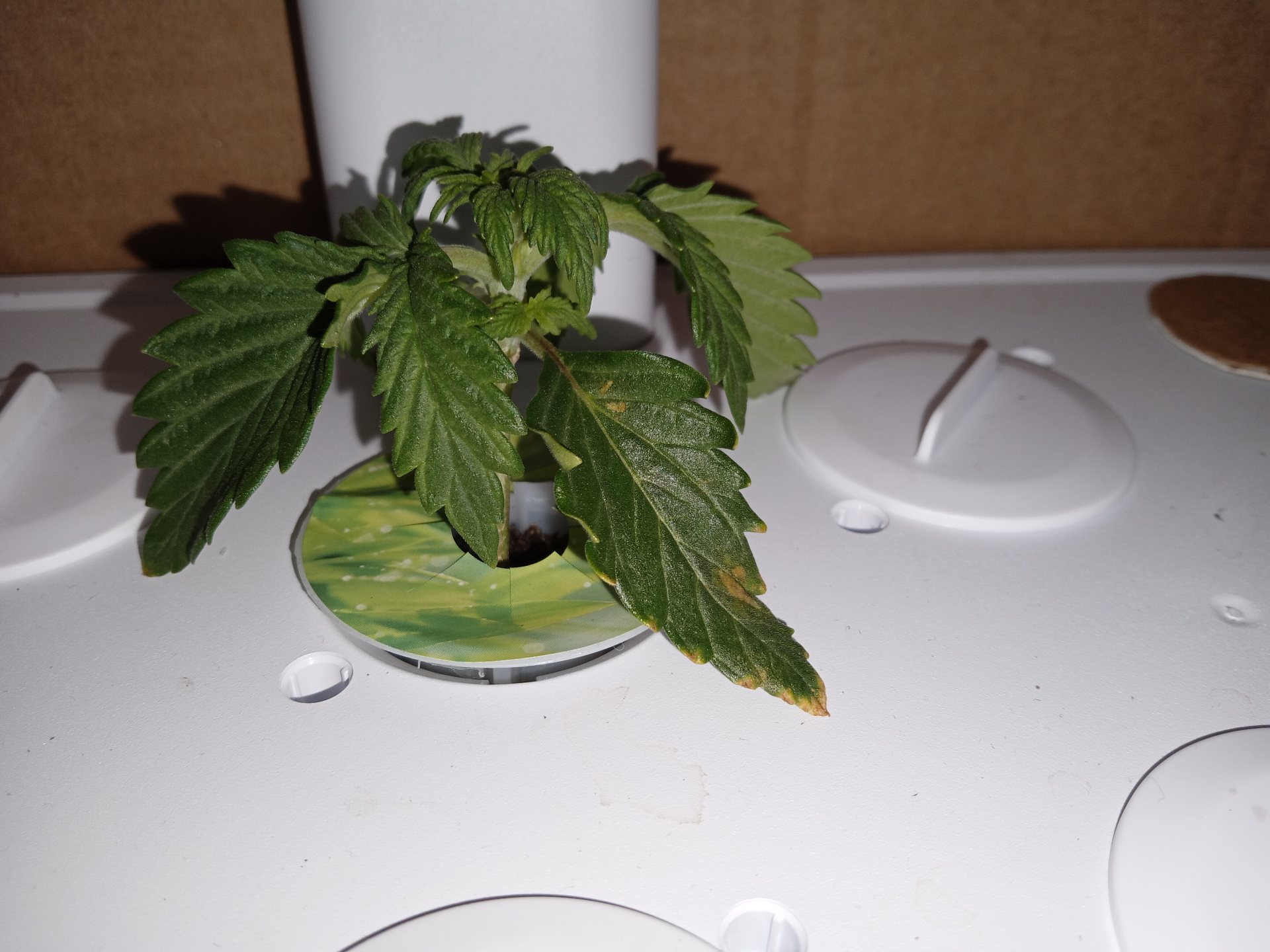
The prior reservoir adjustment was not performed; instead, the reservoir was topped up and fed with 5 ml of each A/B, while dark curl, droop, and tip burn are now visible.
Observation
24 November 2025
- Plant
- Autoflower cannabis
- Health
- ⚠️ Active stress - nutrient strength now a concern
- Momentum
- Stress is progressing
- Case decision
- Continue Case
Visual evidence
What Dud2Bud observed
The plant is still growing, but posture has not improved and the new dark curl with tip burn makes excess nutrient strength more plausible than it was yesterday. The safest next test is dilution without adding another variable.
The plant remains upright at the stem.
Central growth is still present.
The canopy has not collapsed completely.
Leaves remain broadly drooped compared with the previous photo.
Several leaves are darker, curled, and claw-like.
Brown tip and edge damage is now visible on multiple leaves.
The recent 5 ml A/B addition introduced a plausible nutrient-strength change.
Active new damage
Brown tip and margin damage is visible on more than one current leaf.
Active new damage
Leaf curl and downward posture remain active after the prior check-in.
Active new damage
The current symptoms followed a reservoir top-up and nutrient addition, although exact timing and dosage concentration are uncertain.
Old damage
The original isolated lower-leaf damage is not treated as the main issue.
Old damage
The plant's earlier stem stretch is secondary to the current leaf curl and tip damage.
Still uncertain
Reservoir volume, EC, pH, and waterline are not visible.
Still uncertain
The photo lighting differs from the previous photo, so color comparison is imperfect.
Still uncertain
Root appearance and aeration remain unknown.
Dud2Bud decision
Undo the recent nutrient increase
A recent A/B addition coincides with dark curl and tip burn. Diluting the reservoir is reversible and avoids stacking another nutrient dose onto a stressed root zone.
What to do
Dilute the reservoir - no more A/B today
Replace part of the current reservoir solution with plain water, using a conservative partial dilution, then leave the nutrient level unchanged for the next 24 hours.
- 1 Remove roughly one-third of the current reservoir solution.
- 2 Replace that volume with plain water suitable for the system.
- 3 Do not add additional A/B nutrients for the next 24 hours; do not try to repair already-browned tips.
Exact change
Remove and replace about one-third of the reservoir solution with plain water, then add no more A/B nutrients for 24 hours.
Keep steady
Keep the waterline and light schedule steady after dilution. Do not add more nutrients, pH adjusters, or other supplements during the 24-hour test.
Check your own plant
Does your plant look similar?
Upload one photo. Dud2Bud looks at the visible symptoms, growing setup and recent changes, then gives you a practical first step.
First report free · No app required
Full assessment
How this photo was assessed
The report separates visible facts, possible explanations and the final care decision so uncertainty remains visible.
Visible evidence What was visible in the photo
Vigor
ConcernVigor is currently limited even though the plant has not collapsed.
Confidence: 84%
Color Analysis
ConcernDark foliage plus tip burn is compatible with excessive nutrient strength, though root-zone stress can produce similar uptake problems.
Confidence: 78%
Growth Development
ImprovingDevelopment is continuing, but current leaf quality and posture indicate that growth is under stress.
Confidence: 73%
Progress Comparison
ConcernThe previous root-zone hypothesis was not fairly verified because the recommended adjustment was not performed, but the unplanned nutrient addition creates a new high-priority variable.
Confidence: 86%
Damage Classification
Active ProblemThis is active physiological leaf stress, not just old cosmetic damage.
Confidence: 80%
Distribution Analysis
Active ProblemA whole-reservoir or whole-plant factor is more likely than a single damaged leaf.
Confidence: 80%
Possible mechanisms What could explain it
Disease
WatchDisease cannot be ruled out because roots are hidden, but treatment for disease is not justified before correcting the recent nutrient change.
Confidence: 47%
Nutrition
Active ProblemNutrient strength may now be too high for the reservoir volume or current root condition. The correct test is dilution, not more feed.
Confidence: 70%
Environment
WatchEnvironmental demand may contribute, but changing the light now would confound the more immediate nutrient-strength test.
Confidence: 52%
Biotic Damage
ClearPests are not the leading explanation.
Confidence: 75%
Water Relations
Active ProblemWater access and oxygen balance remain relevant, but the new nutrient addition makes nutrient strength the cleaner single variable to change first.
Confidence: 62%
Structural Analysis
WatchThere is no clear mechanical failure; the posture is more consistent with physiological stress.
Confidence: 65%
Decision checks Why this action was chosen
Recovery
ConcernRecovery is not established. The plant needs a controlled corrective step.
Confidence: 84%
Information Gap
WatchMore measurements would refine the next step, but they should not delay a low-risk reduction in nutrient concentration.
Confidence: 76%
Limiting Factor
Active ProblemExcess nutrient strength is currently the leading controllable limitation, with root-zone oxygen and water level still important background factors.
Confidence: 69%
Confidence Audit
WatchConfidence is moderate for nutrient dilution, but low for assigning a precise target EC or declaring root health.
Confidence: 78%
Intervention Evaluation
Active ProblemThe previous experiment is not a failed verification. The new feed change must be treated as a separate experimental factor.
Confidence: 90%
Case reasoning
Cases tracked in this report
Intervening
Water access / oxygen balance stress
What comes next: Dilute nutrient strength without adding more A/B, then compare new growth and posture after 24 hours.
Check your own plant
Does your plant look similar?
Upload one photo. Dud2Bud looks at the visible symptoms, growing setup and recent changes, then gives you a practical first step.
First report free · No app required
This supporting report documents the visual evidence and care decision from one point in a longer plant journey. It is not indexed separately from the main plant story.