Autoflower Cannabis in a LetPot: Air Gap and Droop Recovery
The reset appears partly helpful
After the reservoir was reset to one-quarter strength, new growth looks greener and less curled, while older leaves continue to decline; the case remains in verification.
Observation
27 November 2025
- Plant
- Autoflower cannabis
- Health
- 🌿 Partly recovering - old damage remains
- Momentum
- New growth is recovering
- Case decision
- Close Case
Visual evidence
What Dud2Bud observed
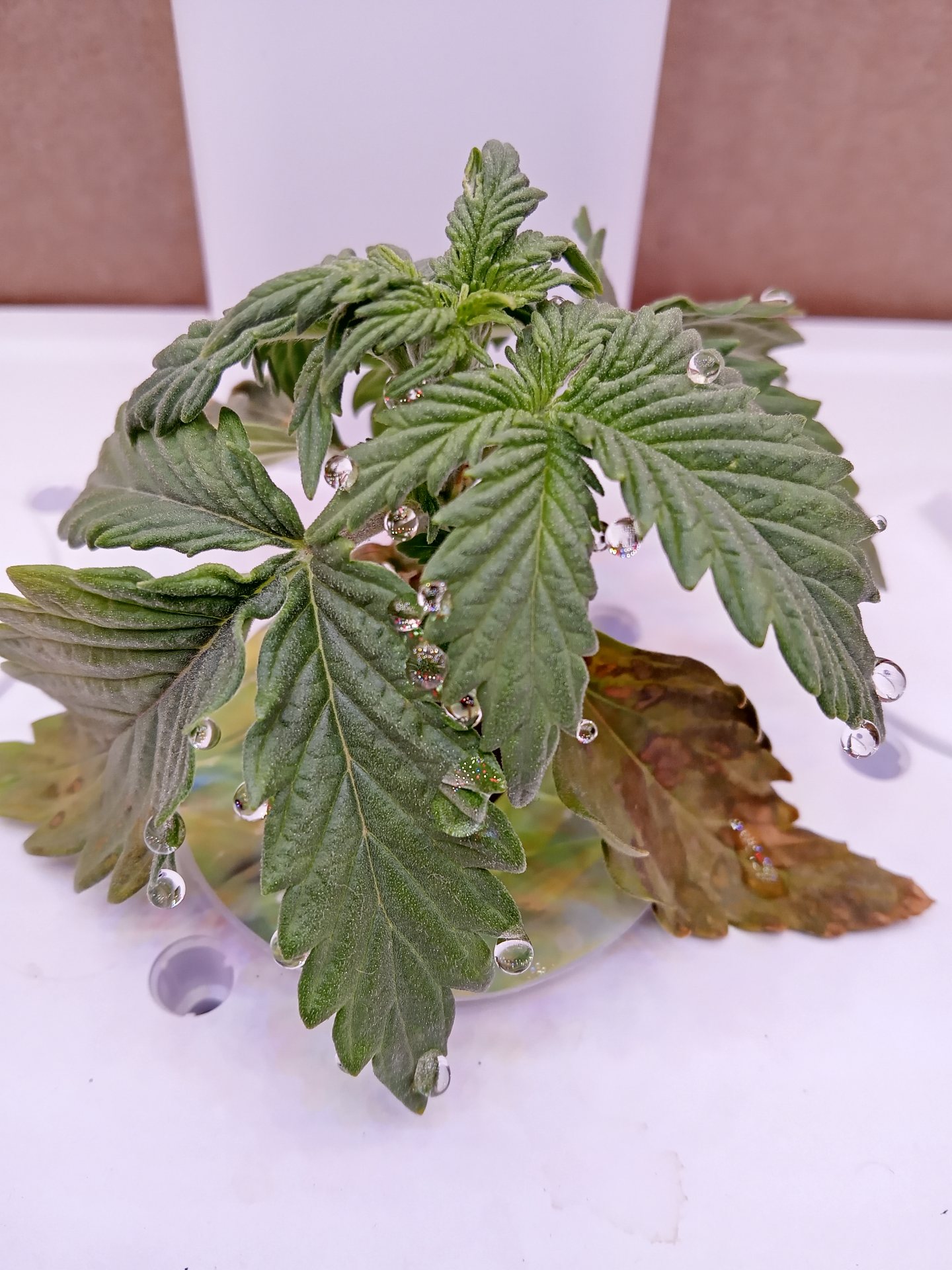
The plant still carries substantial old damage, but the newest growth appears less tightly curled and healthier after the low-strength reservoir reset. This supports partial improvement rather than a need for another immediate chemical change.
New central growth is green and visibly more open than the tightly curled center in the previous photo.
Several newer leaves are holding a flatter shape.
The plant remains upright and has not collapsed.
Older lower leaves are heavily browned, faded, and declining.
Some outer leaves still droop or curl.
Water droplets on the foliage make fine surface details harder to judge.
Old damage
The severely browned lower leaves are treated as established damage and are not expected to regain green tissue.
Old damage
Earlier brown tips and margins are not counted as new damage unless they extend into currently healthy growth.
Still uncertain
The image does not clearly prove whether the waterline or air gap is correct.
Still uncertain
Water droplets may be from recent handling or condensation and limit assessment of leaf surface symptoms.
Still uncertain
Roots, EC, pH, and reservoir aeration remain unseen.
Dud2Bud decision
Hold the improved solution steady
The plant appears to be responding, and changing the reservoir again could erase the useful signal from the one intervention that has helped.
What to do
Hold the quarter-strength reservoir steady
Do not add more A/B or make another reservoir change today. The newest growth looks better after the reset, so give that response a clean comparison window.
- 1 Leave the reservoir at the current one-quarter recommended strength.
- 2 Do not add more A/B, supplements, or corrective products.
- 3 Do not remove the severely damaged leaves yet unless they are fully dead or obstruct inspection.
Exact change
none
Keep steady
Keep the reservoir at the current quarter-strength mix, maintain the current waterline and air gap, and keep light and airflow unchanged.
Check your own plant
Does your plant look similar?
Upload one photo. Dud2Bud looks at the visible symptoms, growing setup and recent changes, then gives you a practical first step.
First report free · No app required
Full assessment
How this photo was assessed
The report separates visible facts, possible explanations and the final care decision so uncertainty remains visible.
Visible evidence What was visible in the photo
Vigor
ImprovingCurrent vigor is improving in the active growth zone, even though recovery is incomplete.
Confidence: 76%
Color Analysis
ImprovingReduced solution strength may be improving current nutrient and root-zone balance, but the older leaves cannot be used to judge rapid recovery.
Confidence: 76%
Growth Development
ImprovingThe plant is producing better-looking growth after the reservoir strength was reduced.
Confidence: 83%
Progress Comparison
ImprovingThe intervention appears to be helping the current growth, but recovery is only partial and should be verified with another stable-care interval.
Confidence: 84%
Damage Classification
ImprovingThe active damage pattern appears to be slowing, while older tissue continues to show the consequences of the earlier stress.
Confidence: 78%
Distribution Analysis
ImprovingThe plant is shifting from active spread toward recovery, though the damaged lower canopy remains visible.
Confidence: 80%
Possible mechanisms What could explain it
Disease
WatchRoot disease cannot be excluded, but improvement in new growth after nutrient reduction makes immediate disease treatment less justified.
Confidence: 49%
Nutrition
ImprovingThe visual response supports excessive solution strength as a contributor, but the exact nutrient or EC problem is not confirmed.
Confidence: 74%
Environment
WatchEnvironment may influence recovery, but changing it now would make the successful nutrient-strength signal harder to interpret.
Confidence: 53%
Biotic Damage
ClearPests are not a leading explanation in this check-in.
Confidence: 78%
Water Relations
WatchWater and oxygen balance may still need watching, but there is no strong reason to change the level while the plant is responding to the strength reset.
Confidence: 56%
Structural Analysis
WatchStructure is adequate for continued recovery; removing major foliage now could add unnecessary stress.
Confidence: 67%
Decision checks Why this action was chosen
Recovery
ImprovingRecovery is beginning in the new growth, but the case should not be closed while the plant is still carrying active posture stress and severe old damage.
Confidence: 82%
Information Gap
WatchMore evidence would refine recovery confidence, but it would not change today's safer choice to hold the corrected solution steady.
Confidence: 70%
Limiting Factor
WatchThe remaining limitation may be residual root stress or damage already committed to older leaves, rather than a need for more nutrients.
Confidence: 62%
Confidence Audit
ImprovingConfidence is good that the low-strength reset helped somewhat, but not high enough to declare the root-zone case resolved.
Confidence: 82%
Intervention Evaluation
ImprovingThe nutrient-strength correction appears partly helpful. It should be continued without adding another intervention yet.
Confidence: 84%
Case reasoning
Cases tracked in this report
Verifying
Water access / oxygen balance stress
What comes next: Keep the reservoir at the current low strength without adding nutrients, then compare only the newest growth after another 48 hours.
Check your own plant
Does your plant look similar?
Upload one photo. Dud2Bud looks at the visible symptoms, growing setup and recent changes, then gives you a practical first step.
First report free · No app required
This supporting report documents the visual evidence and care decision from one point in a longer plant journey. It is not indexed separately from the main plant story.