Autoflower Cannabis in a LetPot: Air Gap and Droop Recovery
Recovery is holding
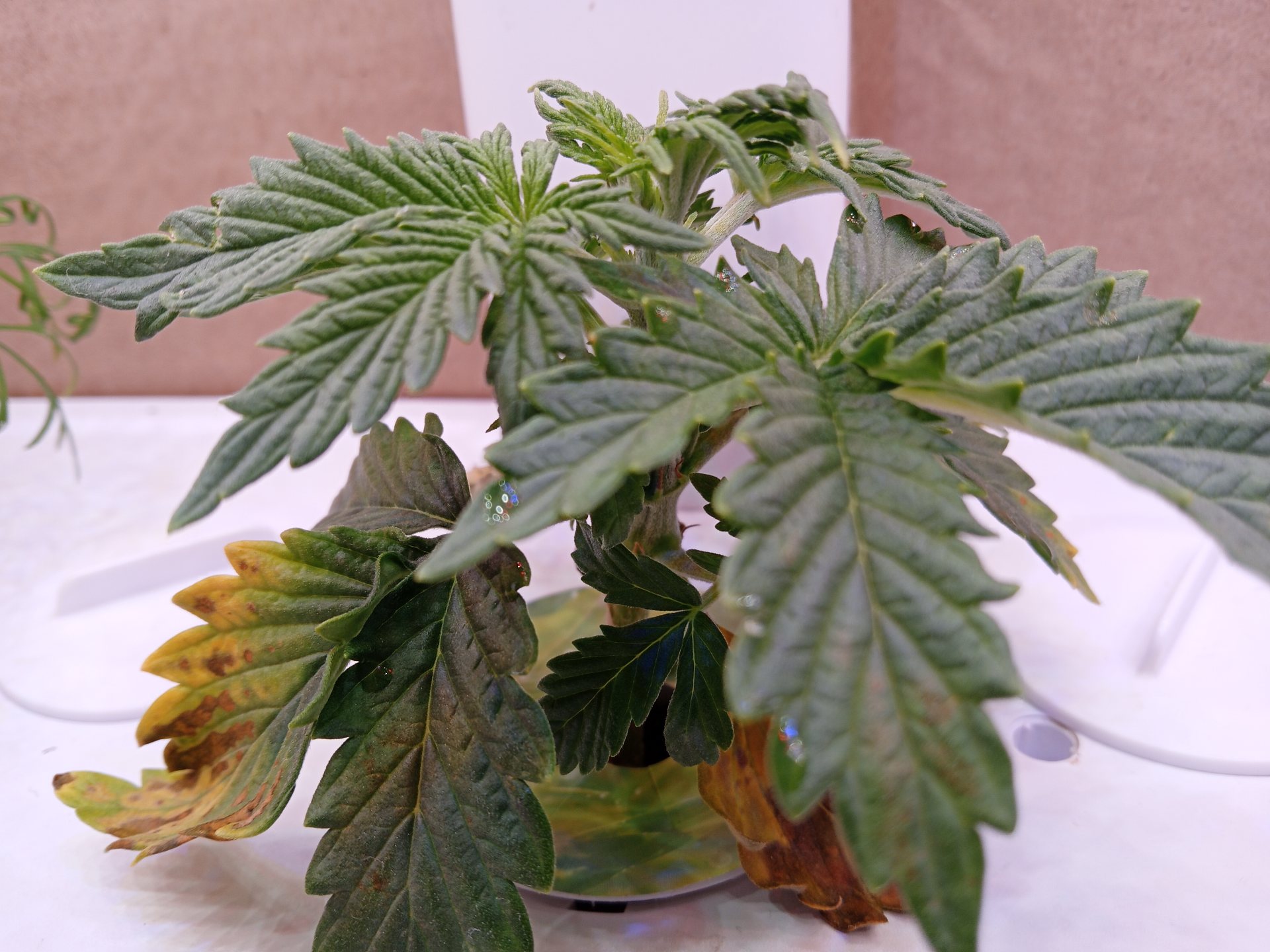
New upper growth expanded and stayed healthier while older damaged leaves continued to fade, supporting a stable-care recovery plan.
Observation
30 November 2025
- Plant
- Autoflower cannabis
- Health
- 🌱 Recovering - old damage remains
- Momentum
- Healthy growth is continuing
- Case decision
- No Case Change
Visual evidence
What Dud2Bud observed
Current growth is moving in a healthier direction. The remaining damaged leaves are mostly older tissue, while the newest canopy shows no clear active spread of burn or curl. Stability is safer than another reservoir change.
The upper canopy has expanded since the previous photo.
New central leaves are green and opening more normally.
The newest growth is not showing the same tight curl seen during the earlier stress peak.
The plant remains upright.
Several older lower leaves are yellowing, brown, or necrotic.
Some outer leaves still hang downward.
The reservoir strength, waterline, roots, and EC are not visible.
Old damage
Brown and yellow lower leaves that were already damaged during the earlier nutrient-strength episode.
Old damage
Existing brown tips and margins that are not extending into the newest leaves.
Still uncertain
The close framing makes exact comparison of posture difficult.
Still uncertain
Some leaf discoloration may be affected by lighting and image angle.
Still uncertain
No user-confirmed recent change is available for this check-in.
Still uncertain
Root condition and air gap remain unseen.
Dud2Bud decision
Protect the recovering new growth
The plant is improving without a new correction, so keeping the quarter-strength reservoir stable is more useful than reacting to old damaged leaves.
What to do
Keep the quarter-strength reservoir steady
Make no new nutrient or water change today. The newest growth is improving, so leave the current solution and root-zone level alone while the plant sheds its older damage.
- 1 Leave the reservoir and waterline unchanged.
- 2 Do not add more nutrients based on the appearance of old leaves.
- 3 Judge progress by new leaves, not by tissue that is already brown or necrotic.
Exact change
none
Keep steady
Keep the reservoir at the current quarter-strength mix, maintain the same waterline and air gap, and avoid adding supplements or extra A/B.
What happened before the next photo
Topped up with 1/2 strength solution.
Check your own plant
Does your plant look similar?
Upload one photo. Dud2Bud looks at the visible symptoms, growing setup and recent changes, then gives you a practical first step.
First report free · No app required
Full assessment
How this photo was assessed
The report separates visible facts, possible explanations and the final care decision so uncertainty remains visible.
Visible evidence What was visible in the photo
Vigor
ImprovingVigor is recovering in the active growth, although the plant is still shedding or losing older damaged foliage.
Confidence: 80%
Color Analysis
ImprovingThe reduced-strength reservoir appears more suitable than the earlier stronger mix, though exact nutrition cannot be confirmed visually.
Confidence: 78%
Growth Development
ImprovingVegetative development is continuing and current growth quality has improved.
Confidence: 86%
Progress Comparison
ImprovingThe trajectory is positive when judged by new growth; old tissue is lagging behind and should not drive a new treatment.
Confidence: 87%
Damage Classification
ImprovingThe stress pattern is becoming residual rather than actively spreading.
Confidence: 82%
Distribution Analysis
ImprovingThe plant is recovering from a past whole-plant stress rather than developing a new canopy-wide problem.
Confidence: 83%
Possible mechanisms What could explain it
Disease
WatchRoot disease cannot be ruled out, but improving new growth makes immediate disease treatment inappropriate.
Confidence: 50%
Nutrition
ImprovingThe earlier nutrient-strength stress appears to be easing. Adding nutrients now could reverse that progress.
Confidence: 72%
Environment
WatchEnvironmental conditions may influence final recovery, but changing them now would add unnecessary uncertainty.
Confidence: 55%
Biotic Damage
ClearPests are not supported as the leading explanation.
Confidence: 78%
Water Relations
WatchRoot-zone water and oxygen balance should remain steady and monitored, but there is no current visual reason to change it.
Confidence: 52%
Structural Analysis
ImprovingStructure is adequate for recovery. Pruning or support changes are not needed based on this image alone.
Confidence: 70%
Decision checks Why this action was chosen
Recovery
ImprovingRecovery is now the dominant story, judged by current growth rather than old leaves.
Confidence: 88%
Information Gap
WatchMore evidence could refine confidence but would not change today's action.
Confidence: 68%
Limiting Factor
WatchThe current limitation is more likely recovery from prior root or nutrient stress than an urgent new factor.
Confidence: 58%
Confidence Audit
ImprovingConfidence is high enough to stop active intervention and continue recovery monitoring, but not yet to call the plant fully recovered.
Confidence: 85%
Intervention Evaluation
ImprovingThe prior nutrient-strength correction appears helpful enough to continue holding conditions steady.
Confidence: 83%
Check your own plant
Does your plant look similar?
Upload one photo. Dud2Bud looks at the visible symptoms, growing setup and recent changes, then gives you a practical first step.
First report free · No app required
This supporting report documents the visual evidence and care decision from one point in a longer plant journey. It is not indexed separately from the main plant story.